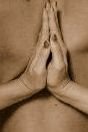
Western style yoga, has become a celebrity trend and been labeled as “exercise.” Celebrities such as Sting, Jennifer Anniston, Gwyneth Paltrow, Madonna, Ralph Fiennes, Julia Roberts, Geri Halliwell, and a growing number of celebrities are renowned for their practice of yoga. Continuous celebrity publicity and viewing them as role models, today’s societies are reflecting celebrity lifestyles. Whether it be the latest fashion, eating at the trendiest restaurants or hanging out at the stylish bars, with the West being an insecure and image obsessed nation, the public also follow the latest fitness fads, and in this case happens to be yoga.
Those who practice yoga, be it a celebrity, or a member of the public who have been influenced by their role models, all have reported health benefits at different levels. Most authors in literature describe yoga as being a mind-body experience when practicing the physical postures, yet is only a small part of yoga, and it is only in traditional eastern cultures, particularly in India, that practice all the deeper elements of yoga. There are many factors that may affect yoga as a mental practice as well as physical. Influences within the class, if used to the best advantage, the physical and non physical aspects of yoga which involve ethical beliefs, control, focus and concentration can be applied in everyday lives. Yoga can slowly improve ones mental state, affect ways of living, attitudes expressed towards others and to some, yoga can increase spirituality and self realization.
Serious practitioners who practice traditionally, study the paths of yoga thoroughly by following it’s deeper roots and consider it as part of a lifestyle and study it as if it were a religion in it’s own right. Yoga is not a religion, but part of the Hindu and Buddhist religion who follow it in depth, which involves philosophy of self, life and nature. The whole spectrum of yoga is not as popular in the Western cultures, however, it is available in specified traditional yoga centers, ones such as the Sivananda yoga Center and Diorama Arts Center in London practice traditional ancient forms of yoga only. They offer teachings of the other areas of yoga, including personal self beliefs, teachings of how to control the mind, creating positivity and other aspects of developing oneself into a healthy individual.
What is Yoga?
The art of yoga is a constant growing phenomenon, originating from India, spreading through the Middle East and to the west. Originally as Stone Age carvings of Hindu philosophy, Indian masters interpreted these images into philosophical scriptures and readings in Sanskrit. Yoga, (‘yuj’ in Sanskrit terms) means union of mind and body. It was developed by “observing nature and searching within themselves (Indians), they evolved physical postures and breathing exercises which stretched, cleansed and centered the body, cultivating states of vitality, clarity and focus.” The aim of yoga is to achieve a balanced state of mind and body.
Yoga is divided up into eight branches; Bhakti, Guru, Jnana, Karma, Raja, Tantra, Mantra and Hatha;
Bhakti is the act of devotion. Commonly practiced by many religious groups, it is expressed through prayer and worship, or in general devotion to acts of life. The aim, through devotion is to detach from the egocentric self and to discover the deeper inner self known as the soul. To achieve spiritual knowledge, a guru would be the ultimate teacher, guiding and training the individual to the path of enlightenment. This is Guru yoga. Using his Bhakti practice he can be devoted to follow the footsteps of his Guru’s experience and knowledge.
Jnana yoga is the notion to distinguish what is real to what is unreal with all aspects of life including behaviors, ideologies and mentality and concepts of self. This leads in the practice of Karma, which is a common practice to all good willed. It involves visible and invisible actions referring to destiny of enlightenment. Practicing Karma seeks to prevention of bad Karma to ones own self or to others in the next life.
Tantra yoga is also known as Kundalini yoga focusing on activating spiritual energies within the human body. It involves strict rituals and visualizations. Some of these rituals may involve chanting of syllables, words or phrases which is referred to as Mantra yoga. The a common syllable used by Hindus and Buddhists is “OM,” and has traveled to the western societies concept of yoga and some teachers like to start and end a class by chanting the syllable three times, creating the preliminary processes of focus and concentration.
Hatha yoga, the main focus of this study, is the physical practice of postures, the most common and identified practice of the eight branches of yoga in the western society. Gurus, masters, teachers and students of India have interpreted the basic physical postures of Hatha yoga and created different styles and techniques. Examples of some of the following styles are commonly practiced in Great Britain. B.K.S Iyengar created Iyengar yoga, specializes in spinal alignment and technique using props, to improve quality, at a low impact and slow pace. Swami Sivananda based his style of yoga using all eight branches which involves religion and philosophical teachings in conjunction with the physical elements of Hatha.
Astanga yoga, the second most popular styles in Great Britain is one of the most physically demanding and mentally challenging styles around today. It was created by Pattabhi Jois(also referred to as Guruji) who used elements of Patanjali’s Sutras (ancient vedic scriptures) as the basis to Astanga which in Sanskrit terms translates to the eight limb system. Raja yoga is the full study of Patanjali's Sutras were interpreted around 400-500 BC by many masters. Through thousands of years, the Sutras have been pre-dated from Patanjali’s ancient text, one individual responsible for this was Pattabhi Jois who constructed the eight limb system, and style of posture were specifically structured into a particular style known as Astanga. It is “based more on psychology than theology... it is a guide to how people, through individual effort, can become fully human. It is about experiencing the true self, the part of you that exists independently of mind and body, and learning to see things as they are without distortion filters of the mind getting in the way.” By learning the sutras, and understanding these ancient scriptures, yoga practice may then be considered mentally as well as physically beneficial.
To achieve the ‘union’ of yoga, one must follow Patanjali's Sutras: Yama and Niyama are the first two external practices of Astanga involving ethical and natural issues. Yama is the practice of moral principles working on the mind and the individual’s way of thinking. It is not just involved in the practices of yoga but also a daily practice that takes place within all cultures. Within this practice are five elements: Non-violence (Ahimsa,) Truth (Satya,) Non-stealing (Asteya,) transforming vital forces to spiritual levels, for example sex (Brahmacharya,) and greedless ness, (Aparigraha.) Niyama involves self discipline and knowledge working towards these five elements: Purity (Saucha,) contentment (Santosha,) self discipline and commitment (Tapas,) self study (Svadhyaya,) and surrender (Ishvara-Pranidhana.) These are particularly important elements to achieve a healthy mind in ones daily outlooks. It teaches one to accept the world as it is with easy or difficult situations and encounters, discourages egotism, and to accept body image and self worth which are highly rated in today's western society. Niyama is the key to learn about the internal and external aspects of self. It helps create awareness of your bodily functions, mental state and actions.
Asana, Pranayama, Pratyhara and Dharana are the next four elements that take place during an Astanga class. Asana are the postures that we practice and pranayama is the breath control we use synchronizing with the movement of postures. Pratyhara is the ability to withdraw the senses of external stimuli that may disrupt an individual physically or mentally. Dharana is the ability to focus attention and hold concentration throughout the practice. These two elements are the mental aspects to focus the mind lead the individual into the next limb, Dhyana (Meditation.) For some, particularly those who practice religiously, meditation will eventually lead to Samadhi (enlightenment and self realization.) Amongst westerners, this is considered or interpreted to be a religious practice and is uncommonly achieved or considered a goal when practicing yoga. It is very hard to achieve and involves lifetime sacrifices of which only serious and devoted practitioners will strive for.

