Januarys Thought
- Februarys Thought - Marchs Thought - Aprils
Thought - May's Thought -
June's Thought - July's Thought August's Thought - Septembers Thought -October's Thought - Novembers Thought - Decembers Thought. |
APRILS THOUGHT: Yoga and Pregnancy
Yoga is an ancient practice introduced
to the western world many centuries ago. Its popularity has become worldwide
and its benefits are evident: the physical aspect of the practice helps
us all to ‘keep in shape’, keeps our bodies healthy and
our systems functioning healthy. On a deeper level, yoga helps us develop
an inner awareness to our bodies and to our lives, and offers us an
insight into the spiritual dimensions of ancient yogic beliefs. As westerners,
we tend to mainly focus on the physical and physiological benefits,
which is why yoga compliments the pregnant women so much.
From a physical point of view, yoga is a form of low impact exercise; avoiding impact on the joints, toning muscles, improving balance, and circulation, therefore suitable for pregnancy. As the body begins to change, hormones swim through the body, and the foetus grows, it is important to prevent any strain or injury that could easily occur with high impact exercise. Providing mother and baby are healthy, there is no reason why exercise should be eliminated from her lifestyle.
If the mother is an experienced yogini prior to pregnancy, she can continue her regular classes, avoiding any contra-indications by using modifications. If the mother is new to yoga, it is important for her to attend special pregnancy classes with an experienced instructor. After pregnancy, yoga is often an easier and more enjoyable form of low impact form of postpartum exercise to begin with.
BENEFITS OF YOGA
ASANA (Yogic postures)
Pregnancy yoga will gently work on the reproductive organs and pelvis
by focusing on hip openers and leg strengtheners, ensuring optimum blood
supply and adequate nutrients to the growing foetus. By directly strengthening,
stretching and cultivating muscles for birth, you will help ease the
difficulties, stresses, tension and physical demands of childbirth and
motherhood. Certain yogic postures are also practiced to alleviate discomforts
caused by pregnancy such as sciatic, morning sickness, heartburn and
ligament pain.
PRANAYAMA (Breath Control)
As the foetus grows throughout pregnancy, the lungs become compressed
and breath becomes short and un-controlled. Awareness and control of
breath during pre-natal yoga will help strengthen the lungs and deliver
vital life force and fresh, nutritious oxygen to the growing foetus.
In addition, many of the powerful techniques will calm the body and
re-focus the mind during the physical practice, and more importantly
during labour. Breath control will help fight against the urge to tighten
up when in pain, and encourage the body and mind to relax instead.
DHYANA (Meditation) AND DEEP RELAXATION
Meditation and relaxation has the ability to calm the mind and body,
reducing any emotional stresses, anxieties and fears that may arise
throughout the course of pregnancy. Inner awareness also helps to teach
the importance of listening to your body, tuning in, and respecting
the cues your body gives, (especially as it grows and changes). Bodily
awareness will encourage conscious birthing techniques when the baby
comes. On a deeper, spiritual level, relaxation and meditation can help
strengthen the connection between mother and baby, both inside and outside
the womb.
CONTRA-INDICATIONS
Whether in a yoga class or at home, lying down on the back
after the 1st trimester, will put pressure on the inferior vena cava,
reducing blood flow and oxygen supply to the uterus. As a result, nausea,
dizziness or shortness of breathe can occur. Modifications can be made,
for example supporting the back with pillows, reducing unnecessary pressure
on the blood vessels.
Relaxin hormone is present from the beginning of pregnancy and throughout. It works to expand the uterus as the foetus grows, softening the bones and connective tissue in preparation for childbirth. As the hormone flows through the body, it is important not to push too far, or stretch too deeply into any given pose, especially poses requiring abdominal strength. Poses requiring knee bends should be practiced with caution to avoid strain or over stretching of the ligaments and tendons. According to studies, any activities, exercise or styles of yoga (such as bikram, ashtanga and dynamic yoga) that cause significant increase in body temperature, should be avoided during pregnancy. Over heating can endanger the growing foetus, and increase dizzy and fainting spells. In addition, fitness or ashtanga devotees need to learn to slow down; As the body changes, a dynamic workout will become too intense during this time.
Poses that cause compression to the uterus, such as poses lying on the abdomen, forward bends, deep twists, backbends and abdominal strengtheners should all be modified. As the belly grows, especially after the 1st trimester, the pelvis no longer protects the uterus, and modifications or elimination of poses should be made accordingly. An experienced pregnancy yoga teacher will instruct how to perform these modifications so that there is space in the hips, abdomen and ribcage area, which makes breathing easier, and offers maximum safety to baby.
Advanced, 1 legged balancing poses, headstands and handstands, which can result in accidental falling can endanger both mother and baby. Even if the yogi is an advanced practitioner, she must respect her body as it changes, and begins to grow; learning to slow down in her practice, and focus on other poses that would benefit her most when it comes to childbirth.
Retention of breath, or rapid breath exercises,
(such as kapalabhati) are contra-indications for pregnancy and should
never be practiced. More awareness should be directed to birthing breath,
three part berthing, ujaii breath and alternate nostril breathing; all
calming the systems of the body and encouraging concentration.
PREGNANCY POSES
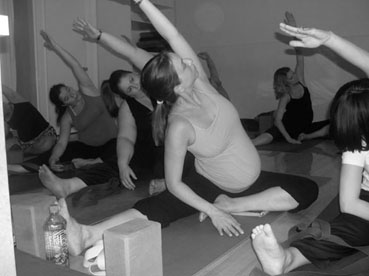 |
Before practicing any of these poses, check with you doctor to confirm whether or not it is safe for you to attend classes. Before joining any pre-natal yoga class, it is important to keep the body hydrated before, during and after, by drinking plenty of water. To avoid any dizzy spells, a small snack is advised at least 15-30 minutes before practicing. This will keep the blood sugar level consistent throughout. Be sure to breath deeply and regularly as you stretch, avoiding retention or strain of breathe. Most of all, listen to your body and trust your instincts. Do what it tells you, and what feels best for you at that time, resting if and when you need to.
Extended Child pose (knees wide) this pose allows the body to rest and open the pelvic area. Relaxing the spine, releasing negative tension in the shoulders, and weight is taken off the body as the abdomen hangs down between the knees and thighs
Cat/cow & downward facing dog. The fluid movements synchronised with breath will work the spine, relieve back pain, strengthen the arms and in the final stages of pregnancy, help get the baby into optimal position for childbirth (see also squats)
Standing/strengthening poses Warrior I, II, III. Triangle, Half moon. Warrior poses will teach physical and mental strength, required for child birth.
Balancing poses Tree, modified dancers
pose. As the weight of the baby changes, observation of balance encourages
awareness, acceptance and patience to the changing body. Balancing poses
become harder during pregnancy, and requires concentration, focus and
engagement of breathe. A balanced body often eflects a balanced mind.
Squats To relax and open the pelvis, strengthen
the upper legs, and promote elasticity of vaginal muscles and pelvic
floor.
Hip openers Pigeon, Bound angle pose, straddle, knee to ankle. All poses work on loosening and opening the pelvic area, keeping the lower back limber and strengthening the legs to give an easier labour.
Bridge pose- An energising, modified backbend which avoids compression of the vertebrae and overstretching the abdomen. It enables flexibility of the spine, strength in the legs and uterus, stimulates the systems of the body, and encourages deep breathing.
Viparita Karani- supported legs up the wall is a modified variation of an inverted shoulderstand. It relieves pressure off the feet, reduces water retention in the ankles and legs, and relaxed pressure on the heart as oxygenated blood supply returns to the heart
Ashtanga Yoga is often associated with a vigorous and dynamic form of physical practice. The structure of an ashtanga class was developed by yoga guru, pattabhi Jois, who is based in Mysore. Pattabhi Jois sequenced different levels of practice, starting with the primary series (Yoga chikitsa-aiming to detoxify and algn the body), Secondary series(Nadi Shodhana- aiming to purify the nervous system and clear energy blockages) and the third/advanced series A, B, C and D (Stira Bhaga-developing a higher level of strength, flexibility and humility).
Ashtanga translates, and refers to the eight limbs of yoga, and thus the physical practice composed of asanas or postures, is just one limb of the ashtanga yoga path, leading to the ultimate goal of enlightenment.
Yama and Niyama
The first 2 limbs of the ahtanga yoga system are associated with morale
and ethical issues to the self and others. Each Yama and Niyama are divided
into principles, and are the foundations for all religious/spiritual beliefs
and practices. Without achieving these intial steps, we cannot further
our path or move onto any of the remaining 6 limbs.
Yama is the prctice of moral and ethical restraints towards others. The 5 principles of yama are; ahimsa (non-violence,non-harming), satya (truth, honesty), asteya (non-stealing), brahmacharya (purity) and aparigraha (non-attachment).
Niyama is the practice of self-observation, individual discipline and inner awareness. The 5 principlesof niyama are; saucha (cleanliness), santosha (contentment), tapas (austerity), svadhaya (self-study) and ishvarapranidhana (surrendering to god or the divine).
Asana and Pranyama
The 3rd and 4th limbs are associated with the physical practice; using
the body and breathe as a tool to clear any physical, spritual or energetic
blocakges within the body. Initially, asana is, and was practiced to prepare
and strengthen the body and mind for the meditative lotus postition.
Asana refers to the yogic postures often practiced in western societies as a form of excercise. Hatha Yoga (as mentioned in the Hatha Yoga Pradipika), is a complete discipline preparing the body for the higher spiritual connection by focusing on practices to balance energy flows on all levels, release blockages and purify the body from toxins, diseases and other waste matters which stand in the way of achieveing the ultimate goal.
Over the centuries, different schools of yoga have developed styles of asana practice, some more vigourous and dynamic than others. All styles of yoga practiced lead to the same ultimate goal. Given are a list of a few popular styles today, and will be explored in greater depth in months to come; Astanga vinyasa, Iyengar, Sivananda, Bikram, Jivamukti, Vinyasa, kundalini and the list goes on.
Pranayama is the practice of breathe control using both simple and more complex techniques. Asana and pranyama work together developing a well controlled and focused practice. Ujaii breathe is just one techniques which can be used hand in hand with the physical movement of asana. It is a powerful technique which allows the back of the throat to contract, and the air passage to open, creating an 'ocean-like' sound. With the flow of the postures, the breathe warms, relaxes and guides the body through movment. Other excercises include Alternate nostril breathing (Anoluma-Viloma), victorious breathe (kapalabhati) shitali, sitkari, Bhastrika, suryabhedana and so on.
Pratyhara and Dharana
The 5th and 6th limbs are assocated with a deeper level of practice and
state of being. Pratyahara is the withdrawal of the senses. Once a deeper
practice is etsablished, a deeper sense of focus, awareness and concentration
or dharana will surely follow, preparing the state of mind for meditation.
Dhayana
The final limb is meditation. The body is now physically prepared to remain
in the meditaive position for a long period of time, the mind is stable,
focused and free from external or internal distractions or obstacles;
and the breathe and physiological systems of the body are calm. With continous
practice of meditation, the ultimate goal can be achieved.
Samadhi
There are several definitions for the final 8th limb; eternal bliss, enlightenment,
ectasy,supreme concioussness and a state of being in union with god or
the higher divine.
As featured in last month's 'Ashtanga Yoga', ahimsa is one of the principles belonging to the yamas; morals, ethics and restraints towards others.
Ahimsa is the act of non-violence, non-injury and non-harming to all beings including the self, others, animals, insects, fish and so on- all exisitng living organisms. Initially, the goal of yoga is to realize that all life is one, and we must practice yoga with compassion, respect and unity.
Ahimsa not only focuses on
the physical aspect of non-violence and non-harming, but also includes
the act of ahimsa in thought and words. To live in ahimsa, one must have
the attitude of harmlessness, respect for all living beings and positive
compassion. By rising above emotions of anger, aggression, hate, jealousy,
fear and attachment, one can enter the true realization of union between
all beings, developing a sense of universal love, truth and harmony.
How we can practice ahimsa
* Engage in a practice which will help to steady the mind and free us
from mental obstacles such as ignorance/lack of spritual knowledge, egotism/self
absorption, attachment to material objects/people and so on. the mind
and breathe will also become unsteady when we experience negative emotions
such as anger, hatred, aggression, jelaousy, impatience and act in a violent
manner. A practice focusing solely on breathe work, for example, pranayama,
or integrating breathe whilst working on challenging poses, can teach
us how to deal with emotions which arise causing unsteadiness and imbalance
in the world around us.
*Self observation and analyzing behaviour of others will help surface any negativity within ourselves so that we can begin to deal with them in a mindful manner.
*Study the lives of those who achieved perfection of ahimsa. for example, Paramhansa Yogananda write the book, 'Autobiography of a yogi.' This book is spiritually enlightening and is recommended for those wishing to gain an insight into their spriritual selves.
*Although asana and pranayama are the 3rd and 4th limbs in ahshtanga yoga, their practices can be used as a tool to work deeper into an ahimsa life. As we are faced with challenging situations, we learn to avoid negative emotions that arise. For example, in yoga class, it is very tempting to watch other students as they work through the asana practice. by focusing solely on your own stage of practice, competition, egotism and compassions can all be avoided- making space for positive aspects of love, compassion and union become possible.
*Finally, learn to practice
in a non-violent fashion towards yourself and your body. It is often tempting
to push yourself into a pose your body is not ready for. Frustration,
anger, even aggression towards yourslef may surface. Our body is used
as a tool in yoga, not our enemy. On a daily basis, our bodies change.
On some days, our bodies may hold more tension and stress than on other
days where they are more flexible and supple. Therefore we need to enter
our daily practice as if it were our first, and work on the poses to the
best of our ability. at times of tension and tightness, remember not to
fight against it or give up, but rather to praise it as it offers us a
certain goal to work on. Yoga asana is not a race or competition, but
an ongoing individual and personal journey leading to the ultimate goal
of samadhi.
Back to top
Karma is a Sanskrit word referring to our thoughts, words and actions. The practice of Karma yoga will reflect on our present and future life. It is thought that the consequences of bad Karma from our reincarnated past lives are reflected in our present lives as difficult/traumatic experiences. It is in our present life that we work to reverse bad karmic consequences by practicing good Karma. If not for our present life, but for the future reincarnation.
For many people and religions, the thought of reincarnation is not believed. However, the act of good Karma applies to all and is a universal truth. We have all heard the expression 'What goes around, comes around.' This is the law of Karma. By expressing bad Karma such as anger, greed, hate, jealousy and egotism, the negative consequences will reflect back at some point.
Through the practice of Ashtange yoga (the eight limb system), the individual will learn to apply the ethical and moral concepts to himself, to others and to the environment; for example, practicing acts of nonviolence (ahimsa-as featured in May's thought of the month). Through this practice of good karma, the heart is purified, negative energy blockages within the body are freed, and the individual is pulled closer to the highest state of consciousness; samadhi, nirvana, eternal bliss.
In today's modern world, we can practice karma yoga once we become consciously aware of our actions, thoughts and behaviors towards ourselves and others. Negative emotions can be controlled, negative actions can be consciously prevented, and selfless acts, serving the community and global contributions can be achieved. It is important to view all beings as equal to oneself, regardless of color, race, sex, financial status, or status of authority.
Good service must be practiced everyday towards everybody and everything (even to those who challenge us physically, spiritually, energetically and emotionally). As a reward, the individual will be honored and respected by all.
A few ways to practice Karma Yoga
* Offer up donations to those less privileged so that they too can live a fullfilled/healthy life
* Participate in nonprofit organizations and charities
* Offer a meal/hot drink (instead of money) to beggars on the street
* Nurture a stray animal with food, take it in as your own, or take it to an animal shelter
* Learn to forgive and forget, so that we can live in harmony with each other
* Instead of dwelling on the negative aspects of someone, think of the positive aspects. This will enhance the good karma to the self
* Learn to stay calm in stressful situations; preventing
physical/mental illness and negative thoughts/actions towards the self
Back to top
August thoughts -
AYURVEDA
Although ayurveda is not yoga, it’s roots are the same; both originating
from India. The word ayurveda comes from the ancient Sanskrit word meaning
‘knowledge of life’. This will make a little more sense once
you understand the concept of ayurveda and the doshas. Ayurveda is an
ancient medicinal practice which observes the person as an individual
being, taking into account lifestyle, diet and personal qualities. Natural
solutions, lifestyle changes, daily rituals, herbal medicines, nutritional
guidance, purification therapies and meditation, are all used to work
together to heal disease and illness. Ayurveda is a patient-orientated
system of healing.
THREE DOSHAS
When visiting an ayurvedic doctor, he will consider your lifestyle as
a whole, and determine your dominating dosha. Each of us have a characteristic
of all 3 doshas, but are predominantly one. This is taken into account
when prescribed an ayurvedic treatment.
VATA
• Body build is often thin and low in weight. Skin is dry, rough
and cold to touch. Vatas have difficulty gaining weight and have always
been thin framed from childhood.
• Appetite is variable, often opting for foods which are sweet,
salty and sour. Vata individuals drink plenty of hot beverages to warm
them up.
• Prone to constipation with dry, hard bowels.
• Vatas are very active people, but tire easily.
• These individuals are creative and artistic
• Moods may vary from joyous to fearful, often feeling insecure
and anxious, and tend to be unpredictable.
• Sleep tends to be light and easily interrupted.
• When vata is balanced through ayurvedic medicine, creativity and
vitality enhance. When vata is out of balance, fear and anxiety will dominate.
PITTA
• Body build is often average in build, height and bone size. Skin
is oily, soft and warm to touch.
• Appetites are strong, requiring larger, but fewer portions, often
opting for sweet, bitter and astringent foods. Pitta individuals enjoy
cold beverages.
• Bowel movements tend to be oily and loose.
• Pittas tend to be moderately active and have a competitive streak
to them.
• These individuals tend to be assertive and aggressive at times,
yet they are organized and intelligent.
• Their moods tend to alter (and are easily altered), when irritated
and jealous, however, Pittas are truly faithful.
• When Pitta is balanced through ayurvedic medicine, contentment
and intelligence enhance. When Pitta is out of balance, anger and aggression
will dominate.
KAPHA
• Body build is larger, bigger boned and stronger, yet can be overweight.
Skin is cool, thick, pale and oily to touch.
• Appetites are small, yet they snack throughout the day, opting
for pungent, bitter, astringent foods. Dry, crispy snacks are eaten regularly.
Kapha individuals rarely drink anything.
• Due to their eating and drinking habits, bowel movements are large
and heavy.
• Kaphas lack in exercise as they lack the initial motivation.
• Although kaphas appear to be the weaker dosha of all three, their
personalities reflect the opposite. They tend to be warm, loving and caring
people who are generally reliable, patient and forgiving. Many kapha individuals
turn to religion and spiritualism.
• Sleep tends to be deep and long.
• When kapha is in balance through ayurvedic medicine, qualities
of love and compassion are enhanced, and when out of balance, insecurities
and envy arise.
When determining your constitution or dosha, you will notice that you will have a portion of all three doshas within your self. It is the dominating dosha that ayurveidc doctors focus on. Once this is done, a nutritional diet can be prescribed according to your dosha, to bring it back to balance from any disruption. Imbalance usually results from stress, poor diet, lack of exercise, poor lifestyle, challenging situations or trauma. Any disruption to the dosha is considered a disease to the body, and it is the study of ayurvedic healing that our doshas return to a balanced state.
AYURVEDIC TREATMENT
Certain rituals are prescribed for daily practice in conjunction with
a dietary plan. These practices include:
Pranayama
There are many techniques and exercises of breathe control that can be
practiced to promote wellbeing. Some techniques are cooling, others conduct
heat and energize the body, so when the exercises are determined, doshas
need to be taken into account.
Massage (abhyanga)
Essential oils are determined and used according to the dosha. Oil is
rubbed into the skin through techniques of massage. In western society,
this technique can be identified as ayurvedic massage.
Rasayama
A meditation of mantras and chants, practiced together with use of herbs.
Yoga
Certain poses are prescribed (or avoided), to balance the imbalance of
dosha. As there are many styles offered, the doctor will suggest which
suits their constitutions the most to enhance the quality of their wellbeing.
Pancha karma
Purification rituals, literally aim to cleanse and balance the entire
body. The cleansing process includes techniques to detox the body through
sweating, vomiting and cleansing of the bowels. Fasting is an example,
and part of a lifestyle for some, to detoxify and cleanse the body.
Septembers thought - Styles of Yoga
All styles and forms of yoga come from the same historical
roots and aim to achieve balance; physically, emotionally and spiritually;
using the body as a tool to cleanse itself, to become closer to self-realization
and to achieve a greater sense of well-being.
Different styles of yoga have evolved throughout the years to meet the
needs of individuals, their cultures and surrounding environment they
live in. Hatha yoga (being one of the oldest and most common forms of
yoga around today), is the branch of yoga focusing mostly on the physical
aspect and the root of all other styles of yoga.
In today’s society, there are now a variety of styles and the styles
chosen to practice is a personal choice. Several focus on a more dynamic
physical practice; whilst others focus mostly on breathe work, gentle
physical movement and meditation. Below is a list of most common ‘named’
styles around today:
Ananda
Developed by Swami Kriyananda (a direst disciple of Paramhansa Yogananda-
author of autobiography of a yogi). A Classical style of Hatha yoga, Ananda
focuses on the breathe work and gentle physical practice to help awaken
the spirit that lies serpent within, the subtle energies and charkas in
the body, and to attune oneself with the higher state of consciousness.
Silent affirmations are used during the postures to achieve deeper awareness
with the spiritual aspect of the practice.
Anusara
Founded by John Friend in 1997, Anusara yoga focuses on amore dynamic
practice including awareness to alignment principles and tantric philosophy.
The ultimate goal in anusara yoga is to celebrate the goodness in all
individuals, to embrace unique differences from person to person, and
humour limitations and talents.
Ashtanga
Developed by K. Pattabhi Jois, Ashtanga yoga is one of the most dynamic
forms of yoga around today. Students will move through a system of set
sequences and series commencing with the primary series thought to the
advanced series. The systems are designed to build strength, flexibility
and stamina through vinyasas (a flow of postures) with the use of strong
victorious breathe (ujjayi breathe). Power yoga is a dynamic form developed
from ashtanga yoga, however differs in its variety of postures and unique
spontaneity. Power yoga was popularized by Bender Birch and Bryan Kest.
See also Vinyasa Yoga.
Bikram
Founded by Bikram Choudhury, Bikram yoga is to be practiced in a heated
room with a temperature of up to 37?C (100?F). With the body warm, the
teacher guides the participants through a sequence of 26 postures, beginning
with the standing poses, the backbends, moving onto the forward bends
and twists, and finishing off with the breath of fire (Kapalabhati).
Integral
Developed by Swami Satchinanda, Integral yoga is used for therapeutic
purposes, combining Pranayama (breath), meditation and asanas (poses).
Integral yoga aims to achieve optimum physical health; control of the
senses; a steady, calm mind; higher level of intellect; strengthened will;
love and compassion to the self and others; a balanced ego; and ultimate
peace, joy and contentment with the self.
Iyengar
Developed by B.K.S Iyengar, Iyengar yoga is famous for its precise attention
to detail when in the physical posture. Most of his postures are learnt
through the use of props which include; straps, blocks, walls and blankets.
The poses are held for longer and practiced several times on each side
before moving onto more advanced postures and Pranayama.
Kripalu
Also referred to as the yoga of consciousness; honouring the wisdom of
the body whilst progressing through a practice emphasizing breath and
fluid movement. Kripalu yoga focuses on individual awareness and reactions
to certain postures; both physical and emotional. There are 3 stages;
the 1st focusing on proper alignment, the 2nd is designed to increase
levels of concentration and awareness by holding the postures for a longer
period of time, and the 3rd stage is like practicing a flowing sequence
whilst in a meditative state.
Kundalini
A spiritual practice which emphasises the release of kundalini energy
or serpent power found at the base of the spine to achieve spiritual transformation
and higher state of consciousness in individuals. The emphasis is mostly
on breath work and chanting- however some classical postures are practiced.
Sivananda
Developed by Vishnu-Devananda, who named the style after his teacher Swami
Sivananda. Sivananda yoga is one of the largest schools of yoga around
today. Sivananda yoga provides an ideal introduction for beginners as
it focuses on Pranayama, 12 classic postures, relaxation and lifestyle
adaptations which enhance optimum physical and mental health such as;
diet, positive thinking and positive living.
Jivamukti
Developed and co-founded by David Life and Sharon Gannon, Jivamukti Yoga
is a fusion of dynamic Vinyasa flow yoga with emphasis on breath, leading
to liberation (Jiva) of the individual soul (mukti). The class structure
includes spiritual readings of ancient yogic scrpitiures and texts, Sanskrit
chanting and meditation. The physical aspect is also practiced alongside
music. Each month, Sharon Gannon and David Life determine a theme to focus
on, so that the yoga practice becomes a spiritual, intentional one, and
not just a physical exercise!
ISHTA
Founded by Alan Finger, ISHTA yoga is an Integrated Science of Hatha,
Tantra and Ayurveda. ISHTA aims to achieve self-visualization and enable
the individual to become more attuned with life’s boundless energy.
The physical practice includes a fusion of the dynamic sequencing of Ashtanga
yoga influenced by strong attention to detail from Iyengar yoga.
Vinyasa Flow
Vinyasa style yoga combines a sequence of postures linked together with
rhythmic breathe to enable a dynamic mind-body workout. Vinyasa yoga is
one of the most popular forms of yoga in the United States, and has developed
through many styles of yoga. Vinyasa flow yoga varies from teacher to
teacher; it can be as dynamic as power yoga or as slow and spiritual as
kundalini yoga.
Back to top
Octobers thought- Self-Realization
Self-realization can also be referred to
as eternal bliss, ecstasy, samadhi,
enlightenment, nirvana, and so on...This is the stage at which we attain
the
highest level of consciousness and become closest to the highest divine,
being or god.
Once we have reached a comfortable meditative
stage in yoga, that which is
free from obstacles, achieving balance and harmony within, when the body
and
mind are steady, we can then enter the self-realization process. The
meditater looses all consciousness of the body and ego when entering the
enlightening state of samadhi.
From a realistic, western perspective, the
final stage of full
self-realization is far from achieving. Only has it been reached by great
gurus and gods. However, we are on the path towards self-realization as
become aware of our lives, our bodies and actions towards ourselves and
others. We also experience moments of samadhi/bliss when tasting a delicious
ice-cream for the first time, or even during the peak of orgasm!
Our goal as western yogis is to work towards
the final goal. And if a
believer of reincarnation, the work that we do in the present life will
be
passed on to our next life, so that the individual is closer to samadhi
at
birth. Western yogis work to achieve universal equality, compassion, love
and gratitude. Only can we serve other in a lovingly and positive way
to
others, when we learn to respect ourselves.
Self-realization is linked to developing
a sense of awareness within
ourselves, our bodies and how we interact and behave towards others.
Self-observation helps us develop a sense of stillness, silence and inner
peace. When external distractions are absent, inner observation will reveal
suppressed emotions and energy blockages to free the mind from conflict
and
self destruction. Through asana practice and meditation, the mind will
enter
the realm of stillness, becoming ultimately aware of nothing other than
peace and silence.
Novembers thought - The meaning of OM
You may have heard, or experienced the single
syllable chant at the beginning or end of a yoga practice. Many yoga schools
integrate the spiritual chant to open and close the asana practice, but
there is more meaning to Om than this. In simple terms, the meaning, and
definition of Om is that of which symbolizes the entire universe through
a single vibration, not on just a physical level, but also on a spiritual
level. The sound of OM depicts the original sound of earth’s creation,
therefore is considered a sacred symbol and vibration across many religions
and spiritual practices. Phonetically, the single symbol word covers all
sounds/symbols within the entire universe, and represents all that is
experienced, all that is said, and all that exists.
In modern, western society, the word has been simplified in the way it
is spelt. Om has been adapted from its original spelling of AUM. Without
true knowledge of the word and its significance, one cannot fully appreciate
the meaning. On it’s spiritual level, each letter, (A, U, M and
a short pause,) all have a reason to it’s existence.
A- This letter and open symbol, which is heard as ‘aah’,
stands for the entire physical world of ones experience. The individual
who currently experiences, the experience itself and those that have experienced,
are all part of the A sound in our OM! Being aware of the world that we
are living, and the body we are experiencing it with, is an example to
the meaning of the A. It is the symbol of the ‘waking’ state.
The 1st experience within the 4 levels of consciousness.
U- This letter, which heard as an ‘oo’ sound, symbolizes that which cannot be seen or altered by our senses. It is the experience of thought; experience in our imagination, our dreams and ongoing mental activity. As the letter and its sound is on a more subtle level to A, so is the subtle meaning to the letter, the experience of the thought world. U is the dream state; the 2nd level of consciousness.
M- This letter symbolizes a level that is deeper than than of thought, which lies deeper into the unconscious, un manifested level during deep sleep. The 3rd level of consciousness.
SILENCE- Following the the 3 experiences of vibrational sounds and different levels of consciousness, one will experience that which is a moment of silence. A slight pause, symbolizing a subtle state of perfect bliss when the individual recognizes his individual identity with the supreme/higher being.
Sanskrit Symbol
Om is seen in many yoga studios as a Sanskrit symbol. The shapes to the
sanskrit symbol also represent many meanings.
Decembers thought - The Koshas
Bodily awareness is something that you
might hear often in many yoga classes. The way in which the body moves,
feels, and works together with the breathe. Awareness of the breathe as
it moves in and out of the body, eases the muscles and ligaments during
a posture. This external awareness of the body is one of 4 layers, and
the easiest to identify.
As an onion would have several layers that can be peeled,
the outer layer is easier to see, easy to reach, and further away from
the inner layer; the core. Consider the onion a metaphor for the human
body. As the layers are peeled away, the closer to the core (or ultimate
bliss) we become. Without removing the surface layer, we cannot identify
the purpose or characteristics of the layer beneath.
ANNAMAYA KOSHA (physical sheath)
Being aware of this outer, physical layer, we gain knowledge of our anatomy;
the muscles, bones, organs and the way that they function. Awareness of
our physical build can determine what does, and does not benefit the body.
For example, how the body reacts to certain foods, overeating, under-eating,
alcohol intake and so on. In our yoga practice, injury is a risk if we
push ourselves beyond our individual limitations, and lack body awareness
and self observation. In a group class, you will notice that our bodies
vary from one person to another, in their appearances. This is due to
varying anatomical structure, physical activity, diet and lifestyle, therefore
different bodies react differently to the same pose. And it is through
yoga, that awareness of our own body reacts to different postures and
movements.
PRANAMAYA KOSHA (vital energy sheath)
The following 3 layers are subtle, unlike the physical makeup of annamaya
kosha that can be seen and touched. The physical body cannot determine
one’s personality. However, the energetic body can determine an
individual’s energy or aura.
Have you ever felt negative energy in a room where an
argument has just taken place.... Or the positive peaceful aura of a particular
person? This is an example of the vital energy sheath. Even though it
cannot be touched, it can be felt by penetrating itself through the physical
body and radiated externally into the atmosphere; which ultimately can
be felt by others who are open to this awareness. In a group setting,
energy can feel its strongest, when radiated from one person to another,
and back again. This is often why individuals opt for group practice over
individual self practice. Next time you sit and meditate, be aware of
the breathe as energy entering the body, and feeling like the body is
bigger than the boundaries of the skin. If you are aware of this in meditation,
you are entering, and gaining awareness of the vital energy sheath.
MANOMAYA KOSHA (mental body)
This is the inner world in which dreams,
thoughts, imaginations, emotions and perceptions are created. A layer
which cannot be seen, or felt by others, yet is responsible for one’s
own decisions, actions and behaviors. The mental body is considered a
superficial layer of activity in the mind because what goes into the mind,
enters and passes quickly without really defining the individual’s
personality.
However, there are some activities that have a stronger hold in the mental world. The deeper layers of manamaya kosha contain the individual’s beliefs and opinions that are formed through society, culture and upbringing. This deeper layer starts to define one’s personality towards the self and others.
Meditation and relaxation are forms of observations to
the mental world. They help us to recognize the superficial layer of manamaya
kosha, and also more importantly, the deeper authentic level. This awareness
brings us closer to understanding the self, and closer to the core layer.
ANANDAMAYA KOSHA (Bliss body)
Once all the layers of our onion have been peeled, we reach the core;
the bliss body. If all our energetic and mental bodies are removed, we
would be left with absolute bliss. Anandamaya kosha is fuelled with natural
ecstasy, nirvana and goodness. Practicing yoga, meditation and prayer
are tools to uncover the layers that hide, and block the layer of bliss;
ultimate happiness.
Negative emotions, depression, physical imbalances, cultural
influences, self hatred and trauma, are few examples that block the unveiling
of the bliss body. It is something we all have somewhere underneath the
body’s layers. Yoga is considered one of the greatest gifts in it’s
power to awaken us to our body of bliss.